Quick answer
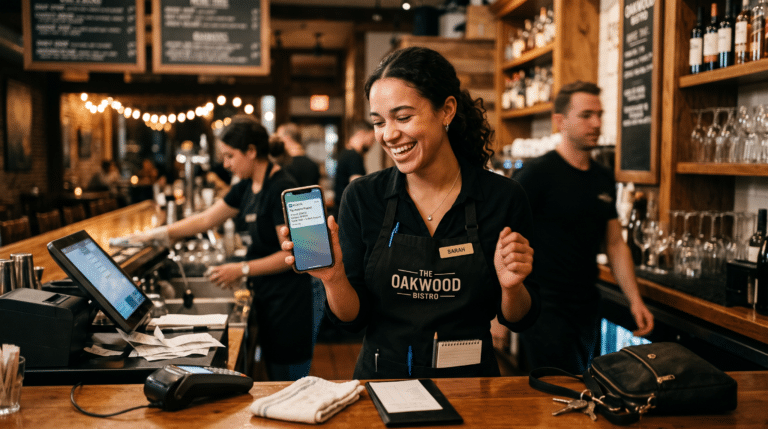
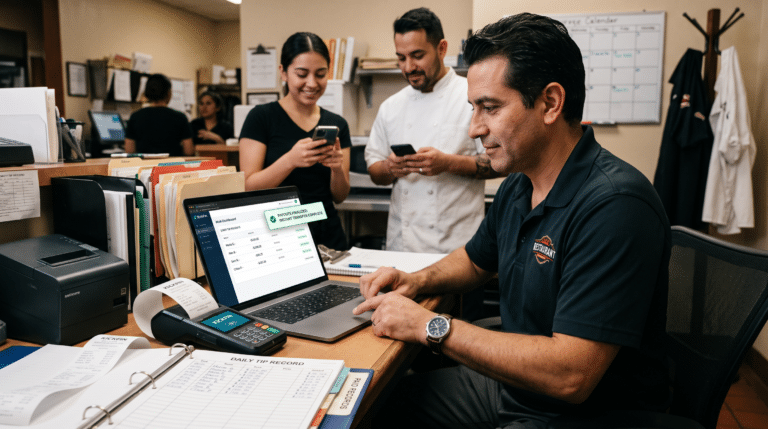
Restaurants stop paying tips in cash by calculating tips from their POS data and sending each person’s share straight to their own bank account after every shift. That ends the bank run, the counting and the manual math, and employees keep same-day access to their money. Kickfin does this for thousands of hospitality locations. Operators that still take some cash can account for it in the same system.
Last reviewed October 2026.
Why do restaurants still pay tips in cash?
Guests stopped paying in cash years ago. They pay by card, tap or phone, so the drawer rarely holds enough cash to tip out at close. Most restaurants still pay out tips in cash anyway, because it is the default nobody chose. Operators patch the gap in one of two ways: managers run to the bank to pull cash, or tips go on payroll and employees wait for the check. Both patches cost something.
Cash, payroll, pay card or direct to bank: how do tip payouts compare?
| Cash from the drawer | Tips on payroll | Pay card the employee must use | Direct to the employee’s bank (Kickfin) | |
|---|---|---|---|---|
| When employees get paid | End of shift, if there is enough cash on hand | Next payday, days to weeks later | Varies by program | Instantly after the shift, any day of the week |
| Cash handling | Bank runs, counting, cash on site | None | None | None for digital tips. Blended Payouts covers any cash still in play |
| Audit trail | Only what someone writes down | Strong payroll record | Card program records | Ledger by location, shift and employee |
| Manager time | High: tip math, counting, bank runs | Low | Low | Low: review and submit |
| What the employee needs | To be there at close and trust the count | To wait for payday | A specific card, which may carry fees or spending limits to move money to their own bank | A bank account they already have. No card, no credit check, no SSN |
The last two columns are the real choice. Cards the employee is required to use add a step between a worker and their own money. Direct deposit to the bank account they already use does not.
What does paying tips in cash really cost a restaurant?
Cash tip-outs tax the business in seven ways:
- Bank runs. With little cash on hand, managers leave the floor to get more, with cash in transit every trip.
- Armored car service. It keeps managers on site, but it is a standing bill that does not fix counting, tracking or theft exposure.
- Idle labor. You pay staff to wait while cash is counted and handed out.
- Theft and skimming. Cash is the easiest target, and large amounts on site put the business and staff at risk.
- Reporting errors. Cash tips are hard to track, which burdens the bookkeeper and creates exposure if the numbers are wrong.
- Disputes and lost trust. Counting errors, real or perceived, erode trust between managers and staff.
- Rounding up. Rounding to the nearest dollar to save time adds up across every tip, every shift.
The costs you cannot see come last. Restaurants and bars lose staff faster than the average U.S. industry (5.5% monthly separations versus 3.3% in 2025, per BLS JOLTS), and workers expect to be paid the way gig apps pay them: instantly.
How do you calculate what cash tip-outs cost you?
Use this table with your own numbers. The example column is illustrative only, for one location, assuming a $25 an hour manager, $15 an hour staff and one tip-out a day.
| Cost | Formula | Illustrative example (one location) | Your number |
|---|---|---|---|
| Bank runs | Runs a week x hours per run x manager hourly cost | 3 runs x 0.75 hours x $25 = $56.25 a week | |
| Manual tip math | Minutes per shift x shifts a week x manager hourly cost | 45 minutes x 7 shifts x $25 = $131.25 a week | |
| Idle labor waiting on the tip-out | Staff waiting x hours waiting x staff hourly cost x shifts a week | 10 staff x 0.25 hours x $15 x 7 = $262.50 a week | |
| Armored car, shortages, skimming | Add your actual monthly spend and write-offs | Not included in the example | |
| Total | Add the rows | About $450.00 a week, or about $23,400 a year |
Your numbers will be different, and many operators run more than one location. The full worksheet is in Cash, Out: the 2027 Digital Tipping Guide.
How do you stop paying tips in cash? A 5-step plan
- Connect your POS. Kickfin integrates directly with major POS systems, so tips, sales and hours flow in automatically. See the integrations page for the current list.
- Set your tip pool rules once. Choose how tips are pooled or shared, and who is eligible, then let the system apply the policy every shift. For eligibility rules, see our guide to tip pooling laws.
- Enroll employees in about 30 seconds. A text, a link, a password and their bank details. No app, no card, no credit check, no SSN.
- Review and submit each shift. A manager checks the details before submitting, which replaces the nightly math and counting.
- Pay instantly to each person’s own bank. Use Blended Payouts for any cash tips that still come in, so every payment method sits in one record.
Learn how this works on the instant tip payouts and automated tip distribution pages, or see how Blended Payouts works.
See it with your own POS data.
What do operators report after they switch?
| Operator | What changed |
|---|---|
| McJunkins Restaurant Group (Walk-On’s franchisee, 17 restaurants) | Nightly tip-out math dropped from about 45 minutes to a few minutes, and bank runs fell from about six a week to about one. Shared publicly on an NRN webinar. |
| Loren Food Group (7 locations, 4 concepts) | More than 12 hours a week saved per restaurant and zero bank runs since switching. Read the case study. |
| Bar Louie (60+ locations) | About 45 minutes a night per restaurant to calculate and pay out cash tips, down to under a minute with the Toast and Kickfin integration, per the company’s SVP of Technology. |
How does digital tipping help with tip reporting and the federal tip deduction?
A 2025 federal law created a deduction commonly called No Tax on Tips. Qualified workers can deduct up to $25,000 in reported tips from federal income tax for tax years 2025 through 2028, with phase-outs at higher incomes, in occupations that customarily receive tips. The catch is reporting. The deduction only applies to tips that are properly reported on a W-2, 1099 or Form 4137, and only to voluntary tips. Mandatory service charges and auto-gratuities do not qualify.
Untracked cash tips cannot be claimed cleanly, and weak records invite scrutiny for the business too. A platform that calculates tips from POS data and writes every payout to an auditable ledger, by employee and by shift, gives you the record this deduction depends on. For the tip pool and manager eligibility rules that sit alongside it, see our guide to tip pooling laws. For the IRS rules on recordkeeping, see the IRS guidance on tip recordkeeping and reporting.
General overview, not tax advice. Deduction amounts, phase-outs and qualifying occupations are set by federal rule and may change; confirm specifics with your CPA. Source: One Big Beautiful Bill Act (2025), federal deduction for qualified tips, tax years 2025 through 2028, per U.S. Treasury and IRS guidance.
Ready to move off cash?
See a payout go from POS data to a bank account, or get the full cost worksheet and the case for going digital.
Frequently asked questions
How can restaurants stop paying out tips in cash every night?
Calculate tips from your POS data instead of by hand, then send each employee’s share electronically to their own bank account at the end of the shift. That removes the bank run, the counting and the cash handling. Operators that still receive some cash tips can account for them in the same system.
Why do restaurants struggle with cash tip payouts?
Guests mostly pay by card, so the drawer rarely holds enough cash to tip out. Managers make bank runs to cover it, spend time counting and doing the math by hand, and carry cash risk and a weak paper trail. Cash payouts also leave employees waiting on a manager at close.
How do instant tip payouts reduce cash handling?
Tips are paid electronically to each employee’s bank account, so there is nothing to withdraw, count or hand out. Bank runs, armored car service and cash left on site drop sharply. Operators we work with report going from several bank runs a week to roughly one or none.
Do we have to stop handling cash entirely?
No. Some guests still tip in cash and some operators want to hand out what is in the register. Kickfin’s Blended Payouts feature records cash tips and cash payouts alongside digital ones, so every payment method is accounted for in one ledger.
What do employees need to sign up?
A one-time enrollment that takes about 30 seconds. Employees get a text, tap a link, set a password and add their bank details. There is no app to download, no card to activate, no credit check and no SSN.
Is putting tips on payroll a good alternative to cash?
It removes the cash, and it creates a clean record. The trade-off is speed: employees wait days or weeks for tips they earned tonight, and workers in a high-turnover industry often prefer jobs that pay them the same day.
How does going digital help with the federal deduction for tips?
The deduction for qualified tips only applies to tips that are properly reported, and to voluntary tips, not mandatory service charges or auto-gratuities. A system that calculates tips from POS data and records every payout by employee and shift produces the record that reporting depends on. Confirm the details with your CPA.
Sources
- U.S. Bureau of Labor Statistics, Job Openings and Labor Turnover Survey (JOLTS), 2025 annual averages
- IRS: Tip recordkeeping and reporting
- U.S. DOL Fact Sheet #15: Tipped Employees Under the FLSA
Educational overview only, not legal, tax, or accounting advice. Tip and wage laws vary by state and city and change often; confirm current rules with qualified counsel and a tax advisor before acting. Kickfin does not determine any employer’s legal or tax obligations.