2025 Roundup: Your Favorite New Tip Management Features

2025 was a defining year for Kickfin and the customers who rely on our software to automate their tip management processes

Driven by direct customer feedback and the evolving realities of restaurant operations, our Product Development team delivered a wave of meaningful enhancements across tip calculation, integrations, user controls, and accounting.

Before we look ahead to 2026, here’s a look back at the product advancements that made Kickfin more robust, more flexible, and more ready to meet the demands of restaurant teams than any other tipping solution.

Advanced Tip Calculator Enhancements

n 2025, we significantly expanded the functionality of Kickfin’s Tip Calculator. Here are a few standout features that we released:

Separate Tips and Auto-Gratuities

Kickfin now tracks tips and auto-gratuities separately, allowing operators to report them independently to payroll and manage them differently for tax purposes.

This distinction is especially important in light of the 2025 No Tax on Tips legislation. While tipped employees no longer pay federal income tax on the first $25,000 in tips earned annually, auto-gratuities, service fees, and other compulsory charges remain taxable.

Kickfin ensures those earnings are categorized correctly from the start — reducing downstream payroll and compliance risk.

House Accounts for Service Charges

Not all service charges are distributed 100% to employees — and Kickfin allows you to handle that with “House Accounts.”

Operators can retain a portion of service charges while distributing the remainder to the team. This is particularly valuable for:

  • Special events and private dining
  • Paying out job roles that don’t typically participate in tip pools (e.g., event managers)
  • Maintaining clarity and transparency around service charge allocation

More Flexible Tip Share Logic

No two restaurants share tips the same way — and Kickfin’s calculator now supports even more real-world scenarios.

Operators can configure tip shares:

  • By shift or by check close, ensuring support staff are compensated appropriately even if they didn’t touch a specific check
  • By hours worked or split evenly, a level of flexibility that remains unique to Kickfin
  • With advanced rules for “remaining tips,” allowing operators to define how servers and bartenders split earnings after support positions are paid out.

These enhancements allow Kickfin to support everything from simple pools to highly complex policies.

Check-Level Edits for Greater Accuracy

POS data doesn’t always capture every nuance, so managers may need the ability to make changes.

Kickfin now supports individual check-level edits for:

  • Cash tips
  • Auto-gratuities
  • Check details and splits

This ensures large parties, special events, and edge cases are handled accurately.

Tip Calculator Change Log for Auditability

Any check-level change made by a manager is recorded in a detailed change log. This creates a clear audit trail, helping operators resolve questions quickly and reinforcing transparency and trust with staff.

Enhanced Functionality for Smarter Cash Handling

Thousands of restaurants use Kickfin because they don’t have enough cash on hand to pay out credit card tips, and they want to reduce the amount of cash handling in their restaurant altogether.

However, we know cash will probably always be a (small) part of the equation. Kickfin makes it easy for you to handle that with some added functionality:

  • Tips left in cash: If a diner leaves a pile of cash at your table, it might not get recorded in your POS. However, Kickfin allows you to record it and distribute it through our platform.
  • Cash payouts: Many operators may want to distribute all of the cash left in their register at the end of a business day to avoid bank runs for deposits. Again, that’s easy to do with Kickfin’s “Blended Payouts” feature.

Enhanced Support for Toast Delivery Service Tips

Kickfin now handles Toast Delivery Service tips more intelligently by excluding driver tips from the general tip pool and assigning those tips directly to the delivery driver. This ensures tips are distributed exactly as intended.

Kickfin delivers on all of those fronts by:

  • Freeing managers up from bank runs and the back office, so they can focus on everything that can’t be automated.
  • Ensuring employees walk out the door with their earnings already in their existing bank account, no waiting, no detours.
  • Helping operators stay compliant, track everything, and uncover new efficiencies.

Expanded POS and Payroll Integrations

New POS Integrations

In 2025, we expanded our POS ecosystem with new integrations including Union POS and rPOWER. POS integrations eliminate manual uploads, reduce errors, and enable real-time tip calculation and reconciliation. Learn more about integrating your POS with Kickfin.

New Payroll Integrations

We also launched new payroll integrations with ADP Run, Paylocity, and Restaurant365 Payroll.

Once activated, Kickfin generates export files that sync seamlessly with your payroll system — significantly reducing manual work for payroll teams.

Looking Ahead

platform that keeps pace with the ever-changing complexity of modern hospitality operations.

If you’re not yet using Kickfin, now is the time to see what advanced tip management really looks like 👉 Schedule a demo today!

If you’re already a Kickfin customer, our team is happy to walk you through what’s new. 👉 Schedule a quick consult to learn more.

And of course: Stay tuned for what’s to come in 2026!

Kickfin Named to Deloitte Technology Fast 500 List for Second Consecutive Year

Kickfin is proud to announce that we have once again been named to the 2025 Deloitte Technology Fast 500™, a ranking of the fastest-growing technology, media, telecommunications, life sciences, fintech, and energy tech companies in North America, now in its 31st year.

Kickfin is the only company on the list purpose-built for restaurants and bars to automate tip management — marking another major milestone for our team, our partners and the thousands of restaurant operators who trust us to modernize their tip-pooling and payout workflows.

Why it matters

When it comes to tipping out employees, cash is no longer king — and needs are changing fast. Hospitality workers demand (and deserve!) faster, cashless payouts; burned-out managers need more hours in their day; and now more than ever, operators care about visibility, compliance, and employee satisfaction.

Kickfin delivers on all of those fronts by:

  • Freeing managers up from bank runs and the back office, so they can focus on everything that can’t be automated.
  • Ensuring employees walk out the door with their earnings already in their existing bank account, no waiting, no detours.
  • Helping operators stay compliant, track everything, and uncover new efficiencies.

What sets Kickfin apart

There’s a reason Kickfin is the best-in-class tip management solution.

  • Broader POS integrations: We’ve expanded our direct integrations with leading POS brands, including Toast, Square, SkyTab, Genius POS, Union, and more — so managers can pool and pay out tips in a matter of clicks.
  • Enhanced tip-pool logic and flexibility: Our platform automates even the complex tip pool policies, with more tip pooling and automated reconciliation features than any other solution, while keeping the end-user experience simple and intuitive.
  • Instant, cashless payouts: With fewer cash drawer runs and real time bank deposits, teams experience faster shift-close, fewer errors and improved satisfaction.
  • Built-in compliance and reporting: As tip-pooling regulations continue to evolve, Kickfin empowers customers with robust features like digital paper trails and payroll integrations to ensure accuracy and compliance from end to end.
  • Customer success focus: Our fully U.S.-based Customer Success team is partners with customers to make onboarding fast and easy, no matter how tricky your tip policy may be, so you get ROI right away.

A big thank you

We’re honored to be recognized by Deloitte, and even more excited about what comes next. For restaurant operators, managers and employees alike, the future of tip management is here, and we’re thrilled to be your partner.

Ready to see what automated tip pooling and instant payouts look like in action? Book a demo today!

New Kickfin Feature Alert: Blended Payouts Are Here!

Brand new feature, coming in hot!

As part of our latest product release, Kickfin now offers Blended Payouts for even easier, fully automated tip management and reconciliation.

Why Blended Payouts Matter

Now more than ever, restaurant guests use credit cards or digital payment methods instead of cash. For many operators, that means there isn’t enough cash on hand at the end of a shift to pay out tips. But employees still want to receive their payouts immediately after clock-out. 

As our customers know, Kickfin solves for those cash shortages by automating and digitizing the payout process — giving you the power to send instant, cashless payouts directly to your employees’ bank of choice, 24/7/365. 

The result: minimal cash handling and risk, better accuracy and tracking — and of course, fewer bank runs.

However, digitizing payouts often results in some leftover cash in the drawer. Over time, we’ve heard from customers who prefer to use up that cash to pay out tips, then distribute the remaining tip amounts via Kickfin. 

With Blended Payouts, you can do just that — and still account for every penny paid out, quickly and accurately, within the Kickfin platform. 

How Blended Payouts Work

As always, all Kickfin customers can still choose to split individual payment amounts between instant payouts and payroll. Once you enable the new Cash Payouts feature, you will now be able to account for any cash tip payments that were also distributed.

Note: This feature lives within Kickfin’s Tip Calculator, which means you must have an active POS integration to use it.

  • Once it’s enabled, you’ll see the new “Cash Payouts” button on the Payment Review screen.
  • After clicking the button, users will be able to enter the individual cash amounts that were distributed to employees.
  • Back on the Review screen, you’ll see instant payout, payroll, and cash payment amounts for each employee. All three payment methods will have their own line items and be accounted for under your Payment Details.

Watch here for a full walkthrough of the new feature.

Ready to enable Blended Payouts? 

If you’re a current customer, in touch with our Customer Success team at support@kickfin.com to activate this new feature.

(Not a customer yet? Click here to see Kickfin in action and learn how you can automate tip pooling and payouts!)

Kickfin Partners with Union POS to Automate Tip Distribution for High-Volume Bars and Restaurants

Kickfin is excited to share the latest addition to our integration marketplace. Read on for all the details around our partnership with Union POS. (If you’re a current Union POS customer and you’d like to learn more about how Kickfin automates tip pooling and payouts, schedule a live demo here.)

AUSTIN, Texas (August 13, 2025)—Kickfin, the leading tip management software, today announced the launch of its integration with Union, the purpose-built POS and engagement platform powering the nation’s busiest bars, nightclubs and restaurants.

Thousands of operators use Kickfin to eliminate tedious tip calculations and remove cash from the tip distribution process so managers can move faster, track everything, and ensure accuracy and compliance.

Untitled design - 2021-04-29T114014.973

By activating the Kickfin-Union integration, we eliminated clunky spreadsheet formulas and fully automated our tip pooling process. After going live, we reduced our time to close out by an average of 30 minutes after every shift.

The Kickfin-Union integration gives Union’s customers the power to auto-calculate tip pools in a matter of clicks and send payouts directly to employees’ bank of choice—no cash or pay cards required.

“By integrating with Kickfin, we’re giving operators the power to choose best-in-class tools that work seamlessly with their Union POS and data,” said Alex Broeker, the CEO and founder of Union. “This direct integration brings automated tip management to our operators while unlocking new opportunities for operational efficiency, employee satisfaction and simplified compliance.”

KPG Hospitality, which operates experiential bars and unique concepts throughout Texas and Tennessee, was among the first operators to activate the Kickfin-Union POS integration.

“Our venues run at a very fast pace. When you consider the time it takes managers to manually calculate tip amounts every day, after every shift, across every location, it’s a lot of unnecessary admin hours,” said Troy Cramer, the managing partner at KPG. “By activating the Kickfin-Union integration, we eliminated clunky spreadsheet formulas and fully automated our tip pooling process. After going live, we reduced our time to close out by an average of 30 minutes after every shift.”Key Features of the Union + Kickfin Integration:

  • Automated Tip Pool Calculations: Calculate complex tip pools in seconds, saving managers hours of administrative work while ensuring accuracy and transparency.
  • Instant Cashless Payouts: Pay out tips directly to employees’ bank of choice instantly, eliminating the need for cash handling and bank runs.
  • Simplified Compliance: Maintain a digital record of every payout, making tip reporting and tax compliance straightforward.
  • Enhanced Tracking: Easily track tips by pay period with comprehensive reporting capabilities.
  • Streamlined Operations: Implement complex tip policies with just a few clicks through an extremely easy-to-use interface.

“Our integration with Union, a leading POS system built specifically to support the busiest venues in the industry, makes perfect sense,” said Kickfin co-CEO Brian Hassan. “Together, we’re creating a solution that saves time, reduces errors, and delivers a better experience for both operators and their staff.”

Available immediately through both Union and Kickfin, venues can integrate their systems and begin leveraging these capabilities today. To learn how this partnership can transform your tip management operations, schedule a demo at GetUnion.com or kickfin.com/demo.

About Union
Union powers a first-of-its-kind venue operating system purpose-built for the nation’s busiest bars and restaurants. More than a point-of-sale, Union connects 1,500+ establishments with 5M+ consumers and leading brands through real-time consumption data. The platform drives operational efficiency, enables frictionless mobile ordering, and facilitates brand-patron interactions that enhance venue loyalty. With $2B+ in annual transactions, Union creates a virtuous cycle where venues improve customer experiences, brands gain direct consumer engagement, and patrons enjoy personalized rewarding hospitality—transforming high-volume operations into next-gen guest experiences. To learn more about Union, visit http://www.getunion.com

About Kickfin
Kickfin is a leading digital tip management platform that automates tip pool calculations and delivers cashless tip payments directly to employees’ bank accounts. Designed to eliminate the administrative burden of tip management, Kickfin helps restaurants, bars, and hospitality venues save time, reduce errors, and improve employee satisfaction. With features like instant payments, digital record-keeping, and simplified compliance, Kickfin is transforming the way venues handle tip distribution in today’s increasingly cashless economy. 

Kickfin vs. TipHaus: Which Tip Management Software is Best for You?

If you’re in the market for tip management software, you might find yourself comparing Kickfin and TipHaus. 

Kickfin is the largest provider of instant tip payouts on the market and has processed more than $2 billion in employee payments for all kinds of restaurants, from “mom-and-pops” to national franchises — and everything in between. 

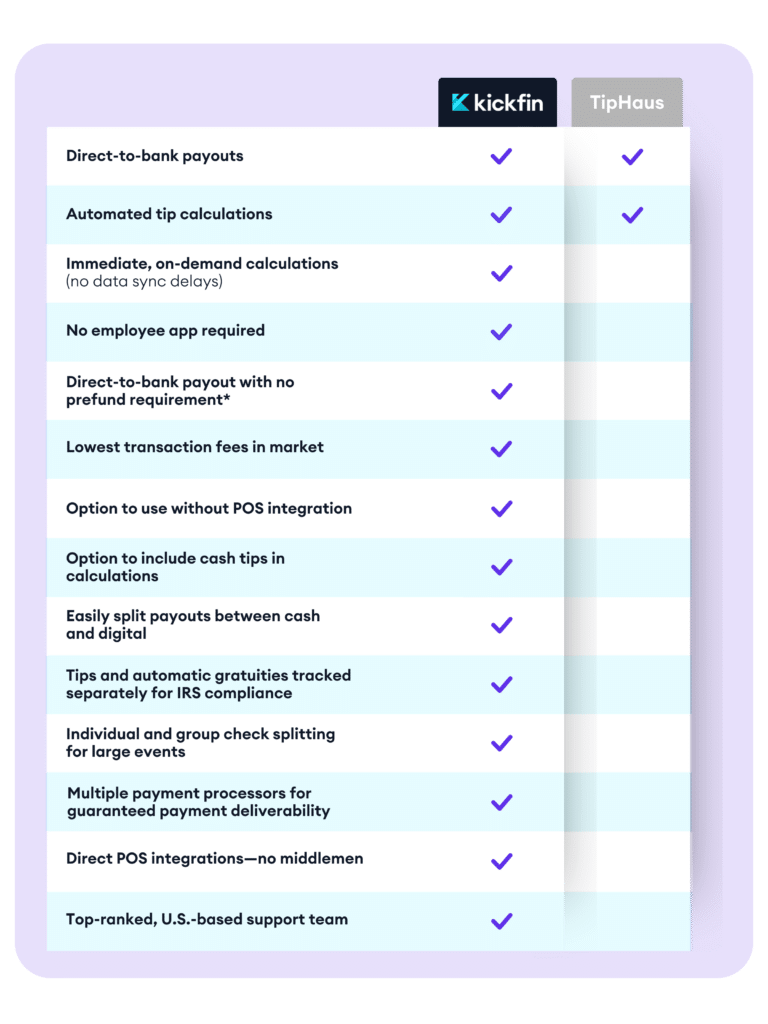
Kickfin and TipHaus are both designed to digitize tip distribution for restaurants. However, there are some significant differences between the two platforms that you’ll want to consider before making a decision. 

Kickfin and TipHaus: Compare at a Glance

Why Do Operators Choose Kickfin Over TipHaus?

Kickfin Offers Better Pricing 

Kickfin’s direct-to-bank transaction fees are more competitive than the transaction fees TipHaus quotes their customers.

This is primarily due to the fact that Kickfin is the largest provider of instant payouts in the country (validated by Visa and MasterCard data), with more than $2 billion in employee payments and multiple payment processor relationships.

Employees Prefer Kickfin

Kickfin was built to make life easier not just for operators, but also for their employees.

  • No app downloads: Kickfin only requires a one-time, 30-second enrollment for employees. (No app downloads or extra phone storage needed!) Payment history and reporting data can be viewed as needed simply by logging into their browser.

  • No paycards required: Kickfin also doesn’t require pay cards, while TipHaus offers “HausMoney” as a primary payout option for employees. HausMoney is essentially a pay card that employees’ tips are loaded onto. Funds aren’t available to use until the following day. HausMoney may be free for operators, but many employees don’t want to be forced to use a pay card due to the hassles of transferring funds to their own bank accounts, as well as the transaction fees and wait times they may incur. They’d prefer their earnings streamed to their accounts instantly, after every shift—which is how most Kickfin customers choose to pay out their employees.

Zero Prefunding* With Instant Payouts

With Kickfin, customers can send instant, direct-to-bank payouts with zero prefunding required.* While TipHaus does offer zero prefund, employee payouts must be sent to a TipHaus paycard (HausMoney). In other words, if you want to use a zero prefund option with TipHaus, you won’t be able to offer instant, direct-to-bank payouts to your employees.

Option to Manually Input Tip Data

With TipHaus, a POS integration is required, and all tip payment data is generated by the software’s tip calculator.

Kickfin was designed for ultimate flexibility. While many customers use Kickfin’s POS integration to auto-calculate tip amounts, some restaurants don’t need automated tip calculations and prefer to use Kickfin unintegrated. That isn’t an option with TipHaus.

Additionally, some Kickfin customers use Kickfin to auto-calculate tip pools, then manually upload other tip data on an as-needed basis. This comes in handy when you need to pay out “extra” staff, like entertainers, security guards, etc.

Easy, Accurate Distribution of Auto-Gratuities and Service Charges

Kickfin tracks Tips and Auto-gratuities separately. As a result, you can report those types of payments to payroll separately and handle them independently for tax purposes.

Why does that matter? In light of the 2025 “No Tax on Tips” legislation, tipped employees no longer have to pay federal income tax on the first $25,000 in tips earned each year. However, they do need to pay taxes on earnings from services fees, autogratuities and other compulsory charges that are not considered tips by the IRS.

(If 100% of your service charges does not go to your employees, Kickfin allows the “house account” to retain a portion of service charges, while the rest is distributed to your team.)

Enhanced Tip Calculation Functionality and Features

Kickfin’s Tip Calculator was designed to be both highly robust—so it can handle the most complex tip pooling policies—while also being incredibly simple and intuitive to use.

A few unique things about Kickfin’s Tip Calculator:

  • No data sync delays: Tip calculations are immediate and on-demand. With Tiphaus, a data sync process is required which can add extra time to your tip calculation process.

  • Built-in flexibility: Kickfin releases new Tip Calculator features on a regular basis based on feedback we regularly source from customers. For example, Kickfin now offers check splitting for both individual checks and groups of checks, making it easier to handle large parties and events.

  • Ease of use: Customers regularly shout out our sleek, high-quality user interface compared to other platforms. Notably, we’ve made it easy for managers to review all details before hitting “submit,” ensuring the accuracy of every payout.

Cash Tip Tracking and Payouts

Many operators choose Kickfin because they don’t have enough cash on hand to pay out credit card tips, and they want to reduce the amount of cash handling in their restaurant altogether.

However, we know cash will probably always be (a small) part of the equation. Kickfin makes it easy for you to handle that with some added functionality:

Tips left in cash: If a diner leaves a pile of cash at your table, it might not get recorded in your POS. However, Kickfin allows you to record it and distribute it through our platform.

Cash payouts: Many operators may want to distribute all of the cash left in their register at the end of a business day to avoid bank runs. Again, that’s easy to do with Kickfin.

Multiple Payment Processors for Guaranteed Deliverability

For many employees, especially those living paycheck to paycheck, it’s critical that they receive their tip earnings and that they’re instantly accessible/ready to use.

TipHaus uses only a single processor. Kickfin uses multiple payment processors to ensure deliverability of payouts should a processor experience a disruption or become insolvent.

Direct POS Integrations

All of Kickfin’s POS integrations are direct API integrations, while TipHaus has been known to utilize third-party software to integrate with some POS systems. The problem with third-party software is that it can be susceptible to more connectivity issues, creating problems with data reliability.

Top-Ranked Customer Support

Kickfin has an award-winning Customer Success team that is exclusively focused on helping our operators get the most value possible out of Kickfin.

Every member of our team is based in the U.S. We provide free, personalized training and onboarding for your whole team, and when questions or issues arise, we can be reached by phone, email, text or chat. We also have a robust library of support documentation and videos that provide step-by-step guidance for every aspect of the platform.

Credibility and Recognition

At the end of the day, Kickfin’s large and fast-growing customer base speaks for itself, as do their rave reviews of the platform.

For multiple years, Kickfin has been the only tip management software that is recognized on both the Inc. 5000 and Deloitte Fast 500 lists. Kickfin has received recognition from peer software review sites like G2 and Capterra for consistently high customer rankings and reviews.

*Zero prefund is available to select customers after a credit review to confirm their fit with the zero prefund program.

Ready to take the next step?

See why thousands of restaurant pros use Kickfin to auto-calculate tip pools and pay out tips in real time, no cash or math required! Get a demo today.


Kickfin Ranked 65th Fastest Growing Company on the 2024 Deloitte Technology Fast 500

We’re thrilled to announce that Kickfin made the Deloitte Technology Fast 500™ list, a ranking of the 500 fastest-growing technology, media, telecommunications, life sciences, fintech, and energy tech companies in North America.

How Kickfin stacks up

Overall, 2024 Technology Fast 500 companies achieved revenue growth ranging from 201% to 153,625% over the three-year time frame, with an average growth rate of 1,981% and median growth rate of 460%.

Our 2,144% revenue growth earned us the 65th spot on Deloitte’s list. It’s another exciting milestone for Kickfin — but more importantly, it’s a meaningful validation of our mission to take the clunk out of tip management, so payouts are faster, smarter and safer for every restaurant team we serve. 

Based on Deloitte’s ranking, Kickfin is:

  • The highest-ranked restaurant tech company on the list
  • The *only* tip management company on the list
  • Austin’s fastest-growing tech company

Growth driven by product innovation, demand for automation

Kickfin was the first digital end-to-end tip management solution on the market — and with more than $2 billion payouts to more than 250,000 restaurant employees, we continue to be the largest and top-ranked.

Why?

It comes down to working the way our customers work — and not the other way around. Not only do we automate the tip pooling and payout process for thousands of restaurants and bars; no two tip policies are alike, so we’ve built a solution that gives them the flexibility and customization they require.

With more than $2 billion payouts to more than 250,000 restaurant employees, Kickfin continues to be the largest and top-ranked tip management software on the market.

That’s a big reason we’ve focused on building direct, robust integrations with the leading POS systems on the market. So far, we’ve rolled out integrations with Toast, SkyTab, Oracle, PAR, Heartland and Square — and the list continues to grow.

“In recent years, digital tip management has become table stakes,” said Justin Roberts, Kickfin’s co-founder and co-CEO. 

“Operators now understand the significant efficiencies to be gained by eliminating manual tip-out processes. It’s no longer a question of ‘if,’ but ‘how.’ As a direct result of our commitment to innovation and customer success, we’re thrilled to see more and more restaurants select Kickfin to modernize their tip management.”

A big thank-you to our customers who trust us with their payouts, to our partners who support, collaborate (and integrate!) with us, and of course, every member of the Kickfin team.

About the Deloitte 500

Now in its 30th year, the Deloitte Technology Fast 500 provides a ranking of the fastest-growing

technology, media, telecommunications, life sciences, fintech, and energy tech companies — both public and private — in North America. Technology Fast 500 award winners are selected based on percentage fiscal year revenue growth from 2020 to 2023.

In order to be eligible for Technology Fast 500 recognition, companies must own proprietary intellectual property or technology that is sold to customers in products that contribute to a majority of the company’s operating revenues. Companies must have base-year operating revenues of at least US$50,000, and current-year operating revenues of at least US$5 million. 

Additionally, companies must be in business for a minimum of four years and be headquartered within North America. 

Ready to take the next step?

See how brands like Walk-On’s, Marco’s, Bar Louie and more are automating tip pooling and payouts with Kickfin. Schedule your 10-minute demo today

Kickfin Ranked Fastest Growing Restaurant Tech Company | 2024 Inc. 5000

Kickfin ranked in the top 3% of Inc.’s 5000 fastest-growing companies — and we’re leading the charge for tip management software. 

Every year, Inc. identifies 5,000 U.S.-based companies that have seen the highest rate of growth over the past three years based on revenue — and this year, Kickfin was at the top of the top.

A few stats we’re pretty proud of:

🏆 Kickfin ranked 189th overall.
🏆 We’re the fastest-growing restaurant tech company on the list.
🏆 We’re in the 💥 top 3%💥  of all 5000 companies.
🏆 We ranked 24th in the Software category.

Since 2020 — in spite of a pandemic, supply chain disruptions, The Great Resignation, and record-setting inflation — we’ve grown by 2,066%.

Our Keys to Success 

We’ll cut right to the chase: We owe our success to our customers. (It’s not cliche if it’s true, right?)

The bottom is that we know the way you pay your staff matters, a lot. Thousands of restaurants are trusting us to handle that for them, and we don’t take that trust lightly.

And of course, we might be biased, but we think we’ve got the best team and partners in the biz. Thanks to everyone who has helped build, support and evangelize Kickfin. This has been a big year for our small but mighty company — and there’s a whole lot more to come. 

This kind of growth doesn’t happen overnight. We’ve been putting in the work to make Kickfin even better for the thousands of restaurants we serve. Here are just a few ways we’ve expanded to better serve Kickfin customers. 

Integrations 

We’re making it easier to access and use Kickfin by integrating with dozens of leading POS systems, including Toast and SkyTab. Using our integration, managers can pull tip data directly from their POS and Kickfin will handle even the most complex tip calculations in a matter of minutes. 

Thanks to our POS partnerships, we’re able to bring a further simplified version of Kickfin to new and existing customers so they can kick cash to the curb. As an early adopter of our Toast integration, Bar Louie has already saved around 15,000 hours in labor annually by cutting their tip calculation time from hours to minutes. 

>> See more customer success stories

Find out if your POS integrates with Kickin, and reach out to our support team to learn how you can activate the integration.

New Features 

Kickfin is no longer just an alternative to cash tip-outs — we’re a holistic solution to your entire tip management system. 

In case you missed it, 2024 has been a big year for our product. In addition to our new integrations, we’ve rolled out some exciting new tip management features, including:

  • Splitting large party tips 
  • Increased security 
  • Reallocating manager tips 
  • Preventing labor cost mistakes 

>> Learn more about Kickfin’s newest features 

Each of these new updates is inspired by requests from operators, managers and restaurant employees who use our product daily — and that’s something that will never change. As we continue to innovate our best-in-class tip management solution, we’ll always be listening to and learning from our customers so we can ensure every need is met and every expectation is exceeded.  

What’s next for Kickfin? 

We’re not stopping anytime soon. Expect to see more POS integrations, more user-friendly features, and more guidance from our amazing customer support team. 

Not a Kickfin user yet? Now’s the time to rise with us! Get a demo of our restaurant-revolutionizing product today. 

We’ll see you next year on the Inc. 5000!

Kickfin Announces New Integration with SkyTab

Exciting news: Kickfin has a new integration with SkyTab!

When SkyTab users activate the Kickfin integration in the Shift4 Marketplace, they’ll have the power to build custom tip pooling or sharing policies, calculate tip amounts, and send tip payouts directly to their employees’ bank of choice! Forget about hours of calculations and counting cash: your entire tip out process can be run in a matter of minutes.

“As an all-in-one restaurant platform, SkyTab has helped tens of thousands of restaurants modernize and optimize their operations,” said Jay Shavitz, Shift4’s SVP of SkyTab Product. “Kickfin is a valuable addition to our marketplace, helping SkyTab customers realize significant time and cost savings by simplifying and improving the tip payout process.”

What does this mean for SkyTab customers?

If your restaurant is going to take advantage of the new Kickfin integration, here’s what to expect:

  • For employees: You’ll be able to leave your shift as soon as you finish your side work — no need to wait around for your manager to count out your tips in cash. All of your tips will instantly hit your bank account, saving you the trip to the ATM and empowering your financial decision-making.
  • Managers: Put away the calculators and spreadsheets. Using Kickfin through your POS will automate all of your complex calculations, allowing you to send tips with just the click of a button. Your late nights in the back office are over!

If you’re already a Kickfin customer, don’t hesitate to contact our support team for help setting up the integration.

When will Kickfin integrate with my POS?

We’re ready when you are! Check out our list of current integrations to see if yours is on there. If not, reach out to us! We’ll let you know if your integration is on our roadmap.

And hey, even if your POS doesn’t support a Kickfin integration (yet), we have simple solutions to your tip management headaches that don’t require an integration. We’d love to tell you more — so drop us a line today.

For more details about the SkyTab integration, check out the full press release here!

[Updated for 2023] 7 Reasons Why You Need a Digital Tipping Solution

In the hospitality world, cashless payments now make up an overwhelming majority of sales. That means most restaurant guests are paying for meals either with credit cards or some form of digital payment (e.g., Apple Pay), and hotel guests are looking for cash-free alternatives to tip hospitality staff. The pandemic only accelerated this trend — making the need for digital tipping options more pronounced than ever before. 

To be fair, restaurants and bars are also driving the increase in cashless transactions. Many brands now offer online ordering, and we’re seeing a rapid roll-out of mobile apps in recent years — which means, of course, that more customers are paying (and tipping) online.

Operating with little to no cash on hand has its perks, but it presents a major problem when it comes to paying out tips to employees. Many restaurants and bars have already switched to digital tip payouts  — but for those that haven’t, now’s definitely the time.

Here’s everything you need to know about digital tipping and how to choose the right solution for your establishment.

What Does Digital Tipping Mean?

In hospitality, digital tipping, or digital tip payments, is the digital transfer of tip payments from one party to another. This can happen in two different ways:

  • A consumer digitally tips a service worker. This transaction is facilitated by tip acceptance software. For example, a hotel guest might scan a QR code or click a link in order to tip their bellhop on the spot.
  • An employer digitally pays out tips to their employees. This is facilitated by tip distribution or tip disbursement software. That means at the end of a shift, business day, or any designated pay period, employees receive their tips digitally. In other words: instead of paying out your bartenders, servers, and other floor staff in cash tips, you distribute tips instantly and electronically. 

What is a Digital Tipping Solution?

Right now, there are two primary ways that employers can instantly and digitally pay out tips to their employees:

  1. Pay cards: Also known as prepaid cards or payroll cards, pay cards are like debit cards in some ways. At the end of a shift, managers digitally load tips onto their employees’ cards. Technically, they’re “instant” — but unfortunately, prepaid cards can be problematic for restaurants. For one thing, these cards typically come with fees. They’re also not accepted by all vendors or at ATMs, and it can take days for funds to transfer from pay cards to employee bank accounts. 
  2. Instant tip payment platform: This is the “gig economy” approach to paying out tips. Much like Uber instantly pays its drivers, an instant tip payment platform allows managers to send tips to their employees’ bank accounts in real time. (It’s even faster than Venmo or PayPal, which put a hold on funds; with an instant tip payment solution, the money goes directly to employees’ accounts, no detours or waiting required.)

For the purposes of this article, when we talk about digital tipping solutions, we’re focusing on tip distribution software.

How Do Restaurants Pay Out Credit Card Tips?

Traditionally, restaurants and bars have paid out credit card tips in cash. At the end of a shift, managers would total each employee’s tips from credit card sales and pay them out based on their reported sales for that shift. The total amount of tips would be pulled out of the register or safe and divided up accordingly.

However, with an increasing number of customers paying with credit cards or digital payments, paying out tips in cash has become more difficult and time-consuming. Not only does it require restaurants to keep cash on hand that’s often not needed to fund their normal operations — but it also opens the door for potential discrepancies or errors when dividing up tips.

Enter digital tipping solutions, which eliminate the need for managers to handle and distribute cash tips. Instead, with tip distribution software, managers are increasingly able to track and pay out credit card tips electronically, saving time and headaches.

What are the Advantages of Digitally Tipping Out Your Employees? 

When you digitally pay out your employees (instead of cash or payroll tips), everyone benefits: your employees, your managers, and your business. There are seven key benefits to making the switch to digital tip payments.

1. Cash Shortage Problem, Solved

As we move toward an increasingly cashless society, the cash shortage problem is one of the most compelling reasons to switch to digital tip payouts. For many restaurants, bars, and hotels, the pandemic was a major turning point: The percentage of credit card and digital transactions rapidly increased, meaning employers often didn’t have enough cash on hand to pay out tips at the end of the day or shift. 

The great thing about digital tip payouts: you never have to worry about having enough cash in the safe at the end of a shift.

That means no more bank runs — giving your managers hours back in their week. And if you’ve resorted to paying for pricey armored car services? That’s an expense you can cut: Using a digital tip payout solution is only a small fraction of that cost.

2. Instant Access to Earnings 

Many employees enter the hospitality workforce because of the promise of daily payouts. That’s been the industry standard for years — but given the cash shortages noted above, it’s increasingly difficult to ensure employees get their earnings at the end of every shift. 

As a result, some employers pay out cash less frequently or make a drastic org-wide shift to payroll tips. But that can be problematic for employees who can’t afford to wait days or weeks for their pay.

Digital tipping solves cash management headaches while giving your employees the instant access to earnings that they expect and deserve.

As an added bonus, when you distribute tips digitally, the funds go directly to your employees’ bank accounts, wherever they bank, which promotes financial responsibility. Yes, earnings are immediately accessible — but your employees are less likely to make impulsive purchases when their money is in the bank, not on their person.

3. The Power of Choice

While instant, direct-to-bank tip-outs are often the best option for restaurant teams, it’s important to keep your employees in the driver’s seat when it comes to how they’re paid. 

As noted above, some restaurants have dealt with a low-cash environment by switching from cash tips to payroll tips. And while payroll has its perks (e.g., low administrative burden), a unilateral change that causes financial strain can negatively impact recruiting, retention, and workplace culture. 

On the flip side of that, you might have employees who are unbanked, meaning pay cards are the best cashless option. 

The right digital tipping solution prioritizes flexibility, so you can give your employees options for how they receive their cashless tips without creating extra administrative burdens for you (or your bookkeeper).

4. Competitive Hiring Advantage

For years now, hospitality employers have faced a tough labor market. It’s always been hard to find and retain good talent — and now, with gig economy employers on the scene (think: Uber, DoorDash), it’s even more challenging. 

Offering instant, cashless tip-outs is one of the best ways to stay competitive not only with other restaurants and hotels but also with the Ubers of the world.

As the hospitality industry continues to bounce back, those employers that offer digital tipping have found that it’s a useful recruiting tool and a true long-term retention play that’s “stickier” than one-time signing bonuses and other hiring gimmicks.

5. Reduce Liability and Room for Error

If you’re making bank runs or having cash delivered to your restaurant in order to distribute cash tips, you’re at a higher risk of theft and skimming. Plus, counting, recounting, and distributing cash leaves room for human error — and can lead to tip disputes, which aren’t fun for anyone. Digital tip outs solve all of these issues.

On top of preventing counting errors, digital tipping solutions can put up guardrails to prevent improper tip pooling practices. Restaurants and bars have a lot of tipping laws to keep up with — and these laws are almost always in flux. With software like Kickfin, you can stay in compliance with federal, state, and local tip laws, no matter where you live.

6. Keep Your Employees Safe

While digital tipping protects businesses from theft, it can keep your employees safer, too.

Many hospitality workers leave their shifts late at night with a pocketful of cash — making them incredibly vulnerable. Unfortunately, it’s not uncommon to hear stories of unsuspecting employees getting mugged (or worse) after closing up.

While there’s a larger conversation to be had about ensuring the general safety of employees, making the switch to digital tips ensures your people aren’t walking out of your establishment in the wee hours of the morning with wads of cash in their wallets.

7. Save Time and Money

Digital tip payouts save restaurants time and money. They don’t require counting, recounting, and distributing tips, giving managers hours back in their weeks. And because there’s little admin work required, checking out at the end of a shift becomes much faster and more streamlined, reducing labor costs. 

Digital tipping also solves for one of the hidden costs of cash tips: often, managers don’t have exact change on hand and they’ll round up to the nearest dollar. When that happens for every employee, after every shift, every day — well, it adds up. Digital tip payouts are always the exact amount an employee is owed, not a penny less or a penny more.

How Do You Choose a Digital Tip Payout Solution? 

There are a couple of different options when it comes to digital tip payout solutions. 

Pay Cards

Pay cards are one way to go when exploring digital tip payout solutions. A lot like debit cards, managers issue pay cards to employees and digitally transfer funds via an integrated software system at the end of each shift or pay cycle. 

The money stays on the card and can be spent using the card itself or deposited into employees’ bank accounts. Or they can even withdraw money from it, just like an ATM card. 

While pay cards might seem like a solid low-cost solution for employers, there are some major drawbacks to pay cards that put your employees at a disadvantage. Reasons to avoid pay cards include: 

  • Hidden fees
  • Long transfer times
  • Low vendor acceptance
  • Fewer regulations

(For more information on why pay cards might not be the best option for your restaurant, see why Rock N Roll Sushi switched from pay cards to Kickfin’s digital tipping solution.)

Instant Tip Payment Platform

Another digital tip payout solution is Kickfin. In fact, it’s the #1 tip distribution software on the market. 

Hospitality employers can set up Kickfin in one day — and it integrates with software you’re already using. Once you’ve uploaded your employees into the Kickfin portal, they can choose to enroll either by text message or email in seconds. Tips are transferred directly into their bank accounts instantly at the end of every shift, so there’s no more waiting hours (or days) to get what they’re owed. 

The Kickfin platform is also a breeze to manage. You can add, remove, or edit employee information easily. Reporting features offer innovative tracking with the ability to roll up payments made over time across locations. Kickfin is safe and secure, meaning we’re 100% PCI compliant. Employees never have to share their personal banking information because it’s not stored in the system. And when you need reporting, download information seamlessly into a .csv file for easy EOY filing. 

Make the Switch to Digital Tipping

Leveraging a digital tipping solution is a no-brainer. The key, of course, is choosing the right digital tipping platform for your business.

To see why restaurants and bars across the country are switching to Kickfin, check out some of our favorite success stories. Or better yet, get in touch and we’ll walk you through a personalized demo of our platform.


Understanding Service Charges for Restaurant Owners

Service charges, a customary practice in numerous industries, have become far more common in the cost-intensive, low-margin restaurant business in recent years.

A service charge is a fee added to a customer’s bill to cover various aspects of service on top of the cost of goods (i.e., food and beverage). Service charges can serve multiple purposes depending on the restaurant’s policies, from supplementing staff wages to offsetting operational costs. 

While service charges are legal, they’re often misunderstood — and somewhat controversial. Diners don’t love being surprised at the end of a meal with an unexpected fee — especially if it’s not clear what the fee is actually for or where it’s going. Many assume it’s a tip (it’s not!), which can negatively impact employees’ take-home pay.

While service charges can be useful for operators who are fighting an uphill battle against inflation or staffing issues, it’s critical to understand exactly what a service charge is (and isn’t), how to implement one, and what to consider when it comes to compliance and reporting. 

What is a service charge in the restaurant industry?

In the restaurant industry, a service charge is a mandatory fee that gets added to a customer’s bill. This fee is typically a fixed percentage of the total bill amount and often ranges from 10% to 20%. 

It’s important to note that a service charge is not a tip or a gratuity, which are voluntary amounts left by customers in appreciation for service provided. Instead, a service charge is a mandatory charge, often used to cover the costs associated with providing the service, such as staff wages, maintenance, or administrative costs. These charges are common practice in many restaurants, particularly in fine dining or restaurants with large numbers of staff. 

As Beth Schroeder of Raines Feldman LLP explained in her recent Hot Tips & Takes interview, the proceeds of service charges are the property of the restaurant to do with as management sees fit.

Service charges for restaurant owners can help to:

  • Compensate for staff expenses: One of the primary reasons many restaurants implement a service charge is to help cover staff salaries and benefits. While tips can often supplement these costs, they are not always reliable and can fluctuate greatly. Service charges provide a more consistent and reliable revenue stream, ensuring that restaurant staff are compensated fairly for their work.
  • Maintain high service standards: Service charges can also be seen as a reflection of the superior service offered by the establishment, as they’re often found in high-end restaurants where exceptional service is part of the dining experience. Funds generated through service charges can be used to invest in training and development programs for the staff, helping to maintain high service standards.
  • Balance food costs and pricing: Implementing a service charge can help balance the cost of high-quality ingredients with competitive pricing for the customers. Restaurants operating in a higher price range often use premium ingredients, and a service charge helps offset these costs without needing to increase menu prices significantly.
  • Share tips equitably among staff: In many establishments, tips are shared among the service staff only. By implementing a service charge, restaurants can ensure a more equitable distribution of tips among all staff members.
  • Offset the cost of bottle service: For restaurants offering bottle service, the associated costs can be substantial. This service often involves premium liquors and additional staff to cater to the table. By applying a service charge, restaurants can help offset these costs.
  • Facilitate large group payments: Service charges are particularly advantageous when catering to large groups or events, such as banquets or parties. A preset service charge can ensure that the staff is equitably compensated for their time and effort and that costs associated with special decorations or other incidentals are covered.
  • Address split meal charges: When large parties dine together and split bills, it creates additional work for service staff. A fixed service charge helps compensate for this increased workload.
  • Accommodate delivery fees: One last case where service charges are common is in covering delivery fees. As food delivery has gotten more popular, restaurants have had to bear the cost of partnering with food delivery platforms. These platforms charge a significant percentage of the order total as their fee. By incorporating a service charge, restaurants can manage these expenses without having to compromise on the price or quality of their food. 

What’s the difference between a service charge and a tip or gratuity?

While this can be confusing to diners, service charges and tips/gratuities are not the same. The key differences between a service charge and a gratuity:

  • Service charges are compulsory. Service charges are mandatory and non-negotiable. Tips, on the other hand, are not required. Yes, they’re often expected — and many hospitality employees rely on them to increase take-home pay — but ultimately, tips are discretionary and generally based on the quality of the meal and service. 
  • Service charges are a set percentage of the bill. A service charge is a fixed percentage of the total cost of a meal as determined by the employer; it generally ranges from 10-20% of the bill. With tips or gratuities, while 15-20% is a customary percentage of the bill, the amount is completely up to the customer.
  • Service charges belong to the employer. Service charges can be used to increase staff wages, but ultimately, it’s the employer’s call as to where those funds go; operators might choose to use a service charge to offset other costs of doing business. Tips, on the other hand, belong solely to employees. Employers can implement tip pools or tip shares to distribute tips more equitably among employees, but it’s illegal for them to keep any portion of tips from any employee. 
  • Service charges are categorized differently by the IRS. When a service charge is used to increase employee compensation, it’s still not considered a tip. It must be reported as a “non-tip” wage.

Tipping on top of service charges

It’s important to understand that tipping is also still typically expected on top of the service fee. 

Again, though a service charge can contribute to the staff’s wages, that’s not always the case. Employers might use service charges for other costs of doing business. When this happens, “service charge” is a bit of a misnomer; that is, customers may (reasonably!) assume that the fee is going to the person or people who provided the service. As a result, customers might be less inclined to leave a tip.

That’s why it’s important for employers to clearly communicate to both customers and employees how the service charge is being used. If it’s unclear, and the charge isn’t being used to increase compensation, it’s likely that employees will miss out on tips. . 

What is an automatic gratuity or auto-gratuity?

Automatic gratuities are service charges, not tips or gratuities. (Confusing, right?)

Automatic gratuities or auto-gratuities are perhaps even more of a misnomer than “service charge” — in fact, some legal professionals advise employers to avoid using the term altogether.

Here again, customers will often assume that their service provider is the recipient of the automatic gratuity (and choose not to leave a tip on top of the auto-grat). Because auto-gratuities are service charges, they belong to the employer. While they can be brought in as non-tip wages for employees, they can also be used for other operating expense.

How service charges impact restaurant employees

Service charges have a significant impact on restaurant employees, affecting their overall income, the perceived value of their work, and job satisfaction. Here are some of the ways service charges influence employees:

  • Income Structure: When paid to the employee, service charges can provide more stable income for employees because they don’t fluctuate like tips.
  • Pay Distribution: When they’re distributed, service charges are usually divided amongst all staff, including non-tipping positions such as cooks and dishwashers. This can lead to a fairer distribution of income.
  • Reduced tip earnings: This may not be problematic if service charges are being paid to the employee. However, as noted above, customers might be less inclined to tip on top of a service charge, which can hurt employees who rely on tips as a significant portion of their wages.
  • Motivation and performance: Given the compulsory nature of service charges, some employees might feel less motivated to provide excellent service, as their earnings are not directly tied to their service quality. On the other hand, it might also alleviate some pressure, allowing employees to focus on providing consistent service without the stress of variable tips.

If a service charge is primarily used for fair wage distribution among employees, it can have significant implications on their wages and tips. This practice can ensure a more equitable wage structure, especially in establishments where behind-the-scenes staff, such as cooks and dishwashers, typically do not receive tips.

Using the service charge for paying employees can bring a sense of fairness and stability to restaurant wage structures, but it also requires clear communication and understanding from both employees and customers to function effectively..

How service charges impact restaurant customers

Service charges offer several benefits to restaurant owners and staff, but also have implications for the customers. These include:

  • Reduced tipping: Customers may believe a service charge is a substitute for a tip and reduce or eliminate their gratuity. Customers may also feel that a mandatory service fee reduces their control over rewarding good service, traditionally reflected through their tip.
  • Surprise costs: Customers unaware of a service charge may be surprised or frustrated when they receive the bill. This could be perceived as hidden costs, which might impact their overall dining experience negatively. 
  • Increased scrutiny of service quality: Knowing that a service charge will be added to their bill, customers might scrutinize the quality of service provided more closely, with customers more likely to be upset  by any small lapse in service.

Potential impacts of service charges highlight the importance of clear communication and excellent service, ensuring customers understand the purpose of the service charge and feel it justifies the quality of their dining experience.

Is implementing a service charge worth it?

Implementation of a service charge can have significant implications for a restaurant’s revenue. From a financial perspective, a service charge can lead to a more predictable revenue stream. Unlike tips, which are subject to variability, service charges are fixed and therefore ensure a consistent addition to the restaurant’s revenue.

However, the success of implementing a service charge largely depends on how it’s perceived by customers and employees. If customers feel that the service charge doesn’t correlate with the quality of service, or if it significantly increases their total bill, they might reconsider their dining choice, potentially leading to a reduction in customer frequency and ultimately affecting the restaurant’s revenue. 

On the other hand, if service charges are used to ensure fair wage distribution and provide a stable income for employees, it can foster a more satisfied and motivated workforce. This can indirectly contribute to the restaurant’s revenue by reducing employee turnover, enhancing service quality and efficiency, and creating a positive dining environment that attracts and retains customers.

How to collect a service charge at your restaurant

The general process for handling service charges is as follows:

    1. Determine how much you will charge: A service charge typically ranges from 10% to 20% of the total bill but can vary based on the restaurant’s specific requirements.
    2. Determine how you will spend the funds: The service charge can either be retained by a restaurant or distributed among employees.
    3. Inform and train staff: Staff should be informed of how the service fees will be used, how it impacts their income, and how it benefits the restaurant. Proper training should be given to employees, particularly those interacting with customers, to effectively communicate the purpose of the service charge and address any customer questions or concerns.
    4. Create clear communication with customers: Customers should be informed about the service charge before they place their order. This can be conveyed through signage at the restaurant, communicated verbally by servers, or noted on menus. 
    5. Implement the charge: Once all of the above steps are completed, you can start levying the service charge on customer bills. This will involve updating your point of sale system and ensuring all staff are trained to handle the new billing system.
    6. Distribute proceeds accordingly: Once you start collecting service charges, proceeds should be distributed to qualified staff members based on your policy. This is something that Kickfin can help with, if you don’t have the ability to cashlessly distribute tips and charges,
    7. Ensure accurate reporting: Follow IRS guidelines for recordkeeping and reporting. When paid to employees, service charges should be treated as non-tip wages and are subject to social security tax, Medicare tax and federal income tax withholding.Employers can’t use these non-tip wages when computing the tip credit available to employers because these amounts aren’t tips.
    8. Monitor and adjust: After implementing a service charge, be sure to monitor its impact on both restaurant revenue and customer satisfaction. Gathering feedback from customers and staff to identify issues or areas of improvement. 

Remember too that it’s crucial that your restaurant remain compliant with local labor and tax laws when implementing a service charge system. This includes understanding how service charges are taxed and how they impact wage calculations. Laws can vary by location, so consult with a legal expert or your local government to clarify any uncertainties and avoid potential legal issues. 

How Kickfin can help

Kickfin offers an efficient and streamlined solution for managing tips in your restaurant. Our platform allows you to easily implement, track, and adjust your tipping system, ensuring a hassle-free experience for both your staff and customers. 

Kickfin is also designed to be compliant with local labor and tax laws, helping you stay within legal bounds when implementing tips for your restaurant. 

To hear more about how Kickfin can help you manage and distribute tips, sign up for a demo with one of our in-house experts.